Iterating Over Elements
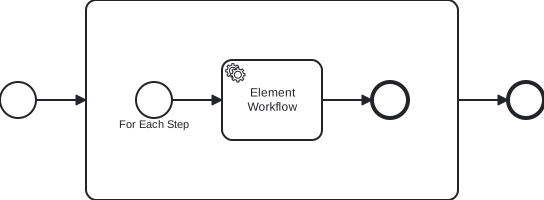
The forEach operation enables workflows to process collections of elements by executing a sub-workflow for each element in parallel1.
This is useful for any scenario where you need to apply the same workflow logic to multiple items.
The ForEach operation takes a collection of elements and embeds a sub-workflow execution for each element. The ForEach step completes when all sub-workflows have finished.
Usage Example
This element is one of the most complicated ones and requires you to configure quite a lot of various aspects:
type Element
type Input
def elementWorkflow: SubWorkflowContext.WIO[Element, Nothing, SubWorkflowState]         = SubWorkflowContext.WIO.pure(SubWorkflowState()).autoNamed()
def getElements(input: Input): Set[Element]                                             = ???
def initialElementState: SubWorkflowState                                               = ???
def buildInterimState(input: Input, subStates: Map[Element, SubWorkflowState]): MyState = ???
def buildOutput(input: Input, results: Map[Element, SubWorkflowState]): MyState         = ???

def eventEmbedding: WorkflowEmbedding.Event[(Element, SubWorkflowEvent), MyEventBase] =
  new WorkflowEmbedding.Event[(Element, SubWorkflowEvent), MyEventBase] {
    override def convertEvent(e: (Element, SubWorkflowEvent)): MyEventBase           = ???
    override def unconvertEvent(e: MyEventBase): Option[(Element, SubWorkflowEvent)] = ???
  }

def signalRouter: SignalRouter.Receiver[Element, MyState] = SimpleSignalRouter[Element]()

val forEachStep = WIO
  .forEach[Input](getElements)
  .execute[SubWorkflowContext.Ctx](elementWorkflow, initialElementState)
  .withEventsEmbeddedThrough(eventEmbedding)
  .withInterimState(buildInterimState)
  .withOutputBuiltWith(buildOutput)
  .withSignalsWrappedWith(signalRouter)
  .autoNamed()
Rendering Outputs
- Flowchart
- BPMN
- Model
- Debug
{
  "forEach" : {
    "meta" : {
      "name" : "Element Workflow",
      "error" : null,
      "description" : null
    },
    "_type" : "Pure"
  },
  "meta" : {
    "name" : "For Each Step"
  },
  "_type" : "ForEach"
}
[ForEach](For Each Step) Elements: 0
Drafting Support
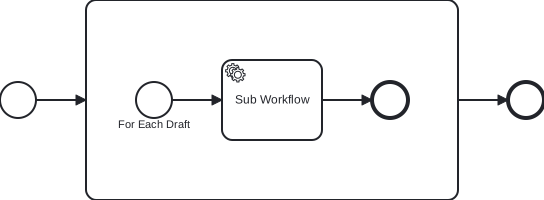
Iterating comes with drafting support.
val subWorkflow  = WIO.draft.step()
val forEachDraft = WIO.draft.forEach(subWorkflow)
Rendering Outputs
- Flowchart
- BPMN
- Model
- Debug
{
  "forEach" : {
    "meta" : {
      "name" : "Sub Workflow",
      "error" : null,
      "description" : null
    },
    "_type" : "RunIO"
  },
  "meta" : {
    "name" : "For Each Draft"
  },
  "_type" : "ForEach"
}
[ForEach](For Each Draft) Elements: 0
Signals
ForEach operations support signal routing so that they can be sent to a specific element's sub-workflow.
This is exposed through SignalRouter abstraction which is split into two parts:
SignalRouter.Receiverrequired when building theWIO.ForEachSignalRouter.Senderrequired to send the signal
Typically, both are exposed by the same object.
Signal Router Types
SimpleSignalRouter
User SimpleSignalRouter when you have direct access to an element on the sender side.
val signalRouter = SimpleSignalRouter[Element]

def element: Element = ???
workflowInstance.deliverRoutedSignal(signalRouter, element, signalDef, request)
BasicSignalRouter
For more complex routing scenarios, you can extend BasicSignalRouter to extract elements from sub-workflow state using custom keys:
type Key
object SigRouter extends BasicSignalRouter[Key, Element, SubWorkflowState] {
  override def extractElem(state: SubWorkflowState, key: Key): Option[Element] = ???
}

def key: Key = ???
workflowInstance.deliverRoutedSignal(SigRouter, key, signalDef, request)
Considerations
- Concurrency - All element sub-workflows run concurrently by default. Consider the resource implications when processing large collections.
- Error Handling - If any element sub-workflow fails, the entire ForEach operation fails. Use appropriate error handling within your element workflows for resilience.
- State Accumulation - The interim state mechanism allows you to collect and aggregate results as sub-workflows progress, rather than waiting for all to finish before processing results.